
ISSUE 0.3
What your medication is doing for you — and what it was never designed to do

Dr. Oluwakemi Olowoyo, MD
I had two C-sections for our two wonderful children, and I am endlessly thankful I did not have to drink alcohol or bite down on a piece of wood or cloth to get through either one — real practices people once had to rely on before modern anesthesia existed. Modern medicine, used well, is one of the great gifts of our time, and I believe in it, used appropriately. I prescribe medications when needed — with real caution, and always as part of a larger plan, not just a prescription pad.
This is not an anti-medication newsletter.
A patient sits across from me — a version of this conversation I hear often — telling me about a recent result from a different provider: "Cholesterol finally over the line." They look at it like it appeared out of nowhere.
"How did I get here?" they ask. Not rhetorically. They actually want to know. And just as importantly — they want to know what else they can do.
That question — how did I get here, and what else can I do — might be one of the most underused pairings in medicine.
What a diagnosis actually is
Most of us treat a new diagnosis as a starting line. The day the problem began.
But a diagnosis is rarely the beginning of the story. It's usually the day the story finally got loud enough to notice.
A diagnosis is not always the beginning of the story. Sometimes it's just the day the story got loud enough to notice.
Your body may have been trying to tell you something for a while — through energy, sleep, digestion, mood, weight, cravings — long before a number on a lab crossed a line someone drew. The diagnosis is not necessarily when the problem began. It is often the moment a developing pattern crossed a threshold, produced symptoms, or finally became visible.
This isn't just a feeling. Heart failure provides a particularly clear example of what can happen when an already vulnerable system becomes destabilized. In one study of older adults hospitalized with decompensated chronic heart failure, an identifiable precipitating factor was found in nearly 9 out of 10 cases. Dietary nonadherence was identified in 52%, medication nonadherence in 30%, infection in 29%, arrhythmia in 25%, acute coronary ischemia in 22%, and uncontrolled hypertension in 15%; some patients had more than one factor. These findings do not tell us what originally caused the heart failure. They show that when a system worsens, something often changed or added strain first. The body may take time to say so loudly enough to be heard.
So here's what I want you to hold onto — a question to carry into every future diagnosis or new prescription, for the rest of your life:
Before asking, or being told, only "this pill fixes this," also ask: What changed in my life that may have led here? What might have contributed to this — and is there anything in my habits, environment, medications, or health history that I can safely work on alongside treatment? What steps got me here, and which ones might I be able to retrace?
This isn't about blame. It's about agency. Blame looks backward to punish. Agency looks backward to learn — then moves forward differently.
This is the question I want you to keep asking, issue after issue, for as long as you read this newsletter: not just "what do I do about this," but "what changed, and what part of it is mine to work with?"
Medications are a trade
Every medication is intended to alter some part of biology — and that same power to help is what makes it a trade. Not because every person will experience harm, but because every treatment decision means weighing expected benefit against possible burden, whether the effect shows up through the same pathway, a different one, or an interaction with something else already in your system.
Your weakest link — the system showing the most strain — isn't necessarily a flaw either. Many of these "weak links" were likely strengths once, in a very different environment. A body that stores fat efficiently was an advantage during famine. A stress response built for short bursts of danger was perfectly designed for an occasional predator, not a decade of low-grade, constant pressure. What shows up now as a weak link is often really a mismatch — ancient wiring meeting a modern environment it was never built for.
What looks like a weak link may once have been a strength — mismatched now, not broken.
That reframe matters, because it changes the question from "what's wrong with me" to "what does this part of me actually need, given what it's dealing with now."
This is not just theory
I have seen this play out, more than once.
A friend was going through a rough season, caring for a family member's health, when her own blood pressure came up high enough that medication was on the table. She had been learning about the foundational pillars of health, and asked her doctor for a little time to work on things first. She did — and not only did her blood pressure normalize, several other areas of her health improved alongside it.
Another friend learned that she had prediabetes and elevated cholesterol, and a statin was being considered. She asked for the same thing — a little time. She started walking consistently. She changed her diet. Three months later, after losing almost 20 pounds, her physician no longer felt that starting the medication was necessary. She has since kept the weight off, and her most recent checkup stayed within normal limits.
I don't share these to suggest this is guaranteed, or that it happens for everyone, or that every condition works this way. It doesn't. But it happens often enough — I have watched people on two or more medications need fewer once they addressed what was actually driving the pattern underneath — that I refuse to let anyone assume their only path forward is adding more.
Dr. O's Take
I want to be honest about the other side of this too: I have also seen people who successfully came off a medication years ago need to go back on it later — because life happened again, and the same weak link got strained in a new season. That's not failure. The good news is that many are able to adjust and improve again from there. Either way, they changed their trajectory. That's just what caring for a body over a lifetime actually looks like: not a straight line, but a relationship you keep tending.
Why medication complexity grows faster than the pill count
Here's something that surprises most people: risk doesn't add up neatly as you take on more medications. It compounds — through combinations, not just totals. With just 2 medications, there's 1 possible pair between them. By 15, there are 105.
| Medications in regimen | Possible medication pairs |
|---|---|
| 1 | 0 |
| 2 | 1 |
| 3 | 3 |
| 4 | 6 |
| 5 | 10 |
| 7 | 21 |
| 10 | 45 |
| 15 | 105 |
This doesn't mean every pair interacts, or that harm grows exponentially just because the math does. It means the opportunity for interaction grows far faster than the medication count itself — and that's just looking at pairs. Three, four, or more medications interacting together at once creates even more possible combinations than this table shows. Evidence becomes increasingly limited when we ask how one person's exact combination of medications, diagnoses, age, kidney function, and physiology will behave together.
And interactions aren't the only concern. There are effects that build up even without any single pair "interacting" in the technical sense:
- Several medications lowering blood pressure at the same time
- Several causing sedation or impaired balance
- Several increasing bleeding risk
- Several affecting electrical conduction in the heart, including prolonging the QT interval
- Several placing extra burden on the kidneys
- Multiple medications with anticholinergic effects, whose burden adds up cumulatively
- One medication changing how the body absorbs, processes, or clears another
- A side effect mistaken for a brand-new disease — and treated with yet another medication
That last one has a name: a prescribing cascade. It's one of the quieter ways a medication list grows without anyone stepping back to ask why.
This is becoming more common, not less. Polypharmacy — typically defined as five or more medications at once — now affects roughly half of older adults worldwide, and that share has been climbing for years, across very different healthcare systems.
In a perfect world, none of us would need any medication at all. We don't live in a perfect world — bodies get dealt difficult hands, and some conditions genuinely require ongoing treatment. The goal is not zero medication. The goal is the right treatment, for the right reason, at the right dose, for the right length of time — and a willingness to reassess when the person's health or circumstances change. For some people, that will mean fewer medications. For others, it will mean a carefully chosen medication that helps protect more of life. The practical goal is the minimum stack your body actually needs — no more, no less — which is really just less medicine, more life in practice.
Conventional medicine already knows this
I want to be clear: this isn't a fringe idea. It's built into mainstream medicine already, even if it doesn't always make it into the exam room conversation.
Guidelines for conditions like high blood pressure, type 2 diabetes, and high cholesterol routinely list lifestyle changes as first-line therapy — sometimes before medication, sometimes alongside it, sometimes as the bridge that buys time before medication becomes necessary. In my own practice, I often start with lifestyle alone for non-emergent chronic conditions, with a clear plan for what to watch for.
Some patients never need medication. Sometimes a documented deficiency or specific nutritional need also deserves attention — but supplements require the same questions about indication, evidence, dose, quality, and safety. We will explore that next month. Some people do need medication — sometimes for a season, sometimes for life — because the stage of life each person is in is different, and the kind of change each person can realistically commit to right now is different too. Medication may serve as a bridge, a protective partner while other changes take effect, or a lifelong necessity. Its role should be determined by what it meaningfully contributes — not simply by how long it has appeared on the medication list.
There's also a specific, respected tool many physicians use called the Beers Criteria. The American Geriatrics Society maintains it to identify medications that may pose disproportionate risks in adults 65 and older, including drugs that should often be avoided, used cautiously, adjusted for kidney function, or reconsidered in particular conditions. The list does not declare every identified medication wrong; it prompts clinicians to make sure its benefit still justifies its risk. It exists because the medical establishment itself recognizes that more medication, stacked over years, isn't automatically better care.
Here's the honest, compassionate truth underneath all of this, though: a 15-to-20-minute visit rarely leaves room to trace back what changed, review a full medication list in depth, or have this kind of conversation — especially when that visit is already consumed by an acute concern. This isn't a failure of individual doctors. It's a structural reality of how modern medical visits are built.
It also helps to know this: nutrition remains underrepresented in medical education. A 2015 national survey of U.S. medical schools found that 71% provided fewer than the historically recommended minimum of 25 hours of nutrition education across the entire curriculum, with reported averages closer to 19 hours total. This is not an indictment of individual physicians. It is one reason detailed nutrition counseling may require additional training, longer visits, or collaboration with appropriately trained professionals. It breaks my heart, honestly, because it partly explains why so many practitioners end up managing the very same conditions, and taking the very same medications, that we prescribe to our patients. It's a systems problem, not a character one. That's part of why, over the years, ongoing training in lifestyle and functional medicine became so important to me — filling in a piece of the picture that medical school itself doesn't fully cover.
What this means for you
If you're an Early Awakener: the next time you get a new diagnosis, before you leave that appointment, ask your doctor one extra question — "is there anything in my daily habits that may be contributing to this, and worth working on first or alongside any treatment?"
If you're a Recalibrator, already managing two or more medications: nothing here means stop anything on your own — please don't. But it does mean this is worth a real conversation with your prescriber: "Is there a version of my care where, if I make real changes, we could safely revisit what I'm taking — or at least change my trajectory?"
If you're a Forward-Looker: this is your reminder that prevention now is the best insurance against needing this conversation later at all. Your version of the question: "Is there anything currently being monitored or trending in a direction that's worth addressing now, before it becomes a diagnosis?"
🎯 Your one action for this month
The next time you're handed a new prescription — or the next time you review your current medication list — ask your doctor this one question out loud: "What changed in my life that may have led here, and is there anything I can safely work on that might help me need less over time, or at least change my trajectory?"
If you want to go further: you can also ask what the medication is expected to do for you, how you'll know whether it's working, and under what circumstances you'd revisit the dose or continued need — but the one question above is the place to start.
Never stop or change a medication without your prescriber's guidance — some medications are dangerous to stop abruptly. This is about opening a conversation, not making a unilateral decision.
And if you're comfortable, tell me in the comments — I'd love to know what question you're planning to ask, or any general questions you have about this month's topic. I know this is one that tends to raise a lot of them.
This newsletter is free for now. If it's useful to you, share it with someone who'd benefit — and if you're new here, welcome! The first few issues are always free to read, so you can catch up anytime.
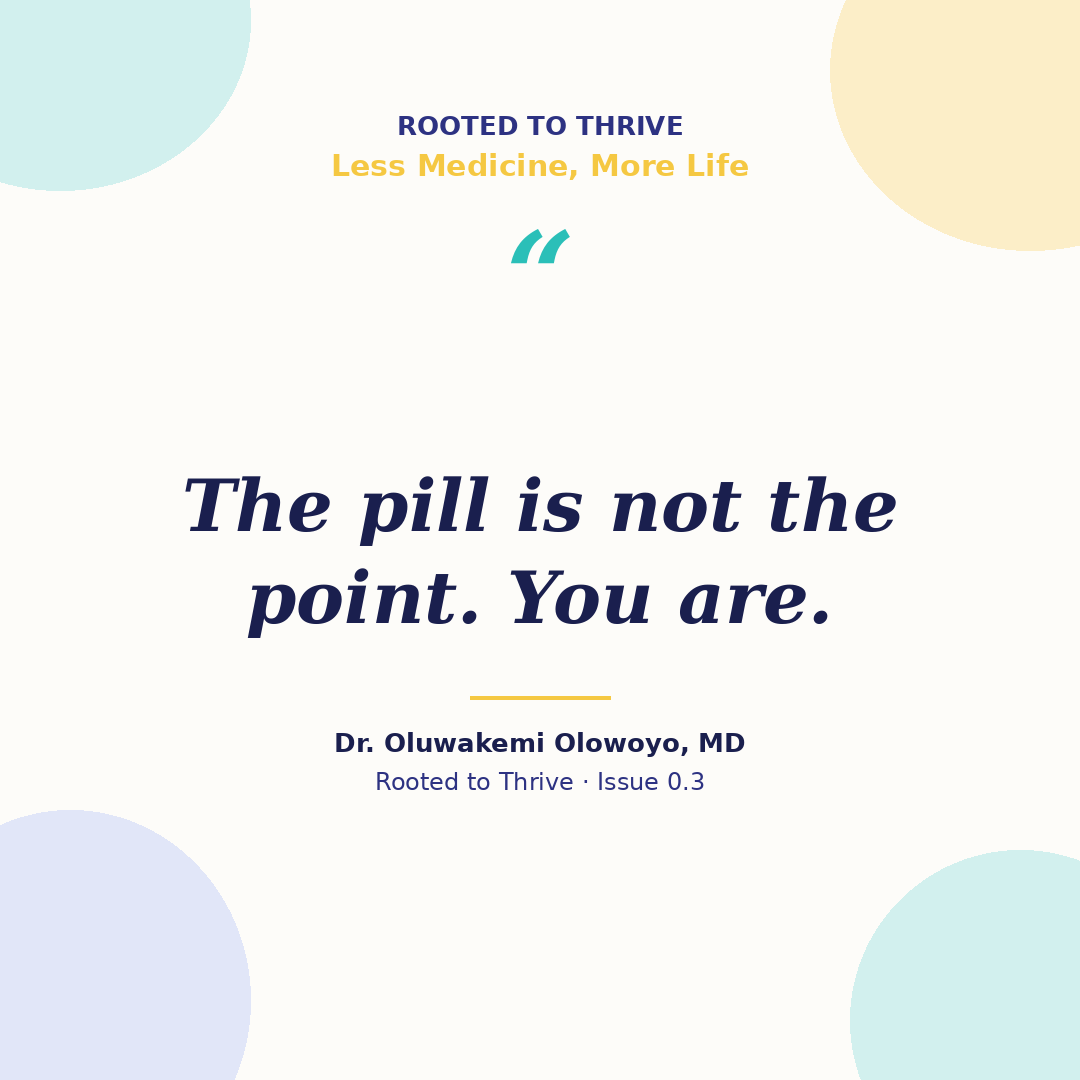
You are not against your medications. You are not for them either, blindly. You are the one steering the ship — asking what's actually needed, staying curious about what changed, and refusing to assume more is always the answer. The pill is not the point. You are.
You'll hear from me like this every second Tuesday of the month, and next month, we'll pick up the other half of this theme: supplementation, and why it needs the same rigor as any other treatment.
To your health,
Oluwakemi Olowoyo, MD
Perisson Optimized Health
Live abundantly, optimize your health.
This newsletter is educational in nature and is not a substitute for personalized medical care from your own physician. Always talk with your doctor before making changes to any medication or treatment plan.
Sources referenced in this issue:
Diaz A, Ciocchini C, Esperatti M, et al. Precipitating factors leading to decompensation of chronic heart failure in the elderly patient in South-American community hospital. J Geriatr Cardiol. 2011;8(1):12-14.
Adams KM, Butsch WS, Kohlmeier M. The State of Nutrition Education at US Medical Schools. J Biomed Educ. 2015;2015:357627.
2023 American Geriatrics Society Beers Criteria® Update Expert Panel. J Am Geriatr Soc. 2023;71(7):2052-2081.
Global prevalence, trends, and dose-response associations of polypharmacy in older adults. PubMed PMID: 42412515.

Responses